

JGLR 52(2) is out; Editor’s Choice article by Reavie and Estepp on Lake Huron’s ecological history
Apr 1, 2026
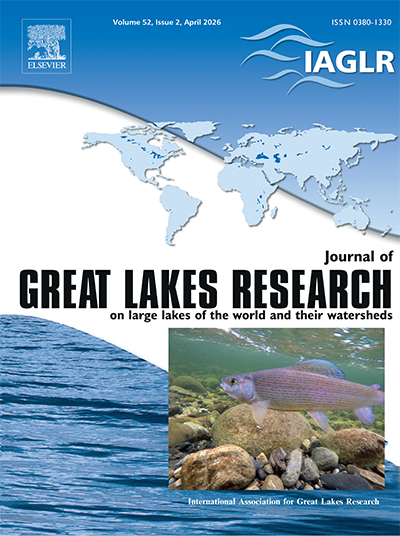
The Journal of Great Lakes Research, Volume 52, Issue 2 is now online. The Editor's Choice article for this issue is The ecological history of Lake Huron according to phytoplankton by Euan Reavie and Lisa Estepp from the University of Minnesota.
The article, selected by JGLR Editor Margaret Docker, presents a comprehensive chronological review of Lake Huron's phytoplankton history, integrating paleoecological records with monitoring data to track environmental changes across three time periods—pre-Euro-American settlement (pre-1915); early- to mid-20th century (1915–1999); and the modern era (2000–present)—to show significant ecological changes driven by human catchment activities, invasive species, and climate change.
Paleoecological phytoplankton records from the pre-settlement (baseline) period show naturally oligo-mesotrophic conditions with occasional mesotrophic periods, and the natural condition became more oligotrophic following Holocene flooding. Early anthropogenic impacts, mainly nutrient enrichment, began in the late 19th century due to agriculture, urbanization, and industrial activities, and these stressors were reflected in the phytoplankton by increases in more nutrient-tolerant taxa. Nutrient pollution peaked in the mid-20th century, resulting in high cyanobacterial abundance. Legislated nutrient reductions improved phytoplankton conditions by the end of the 20th century, but by that time, impacts from invasive filter-feeding dreissenid mussels and atmospheric warming had become established as new stressors that continue to reshape the lake's phytoplankton communities. The worst cases of eutrophication were largely limited to isolated coastal areas, but Saginaw Bay continues to experience eutrophication and annual cyanobacterial blooms, and even the generally oligotrophic North Channel and Georgian Bay experienced localized nutrient enrichment and climate warming that have caused shifts in their phytoplankton communities.
Lake Huron is the fourth Laurentian Great Lake for which Reavie and his colleagues have provided such detailed summaries of the changing phytoplankton communities. Given their location in Duluth, Minnesota, Reavie and Allinger started with Lake Superior in 2011 (What have diatoms revealed about the ecological history of Lake Superior? Aquatic Ecosystem Health & Management, 14: 396-402), followed by Allinger and Reavie (2013) The ecological history of Lake Erie as recorded by the phytoplankton community and Estepp and Reavie (2015) The ecological history of Lake Ontario according to phytoplankton, both published in the Journal of Great Lakes Research. All that remains now is Lake Michigan.
Reavie leads a team of Great Lakes researchers with a major focus on both phytoplankton monitoring and paleolimnology in the Great Lakes. As Reavie explains, “To make those data most useful, we have to understand everything that came before, because predicting Great Lakes trajectories requires historical context. We now have a good idea about the ecological trajectories of the lakes because we can put modern conditions in the context of ~200 years of historical phytoplankton data. It is our EPA-supported mandate to track change in the lakes. Putting together these detailed summaries of all the previous research ensures we have the whole historical context in one place. We hope the summaries are helpful to others as well!”
IAGLR
4840 South State Road
Ann Arbor, MI 48108
(734) 498-2007
office@iaglr.org
Discover
Get Involved
Stay Connected


The International Association for Great Lakes Research is a U.S. 501(c)(3) nonprofit organization.
© 2026 International Association for Great Lakes Research